When Your DogReacts,Do You Know WhatThey're Trying to Tell You?
Barking. Lunging. Staring. Freezing. Pulling. Spinning.
Maybe it happens when another dog appears. Maybe it's people. Maybe it's bicycles, cars, noises — or seemingly nothing at all.
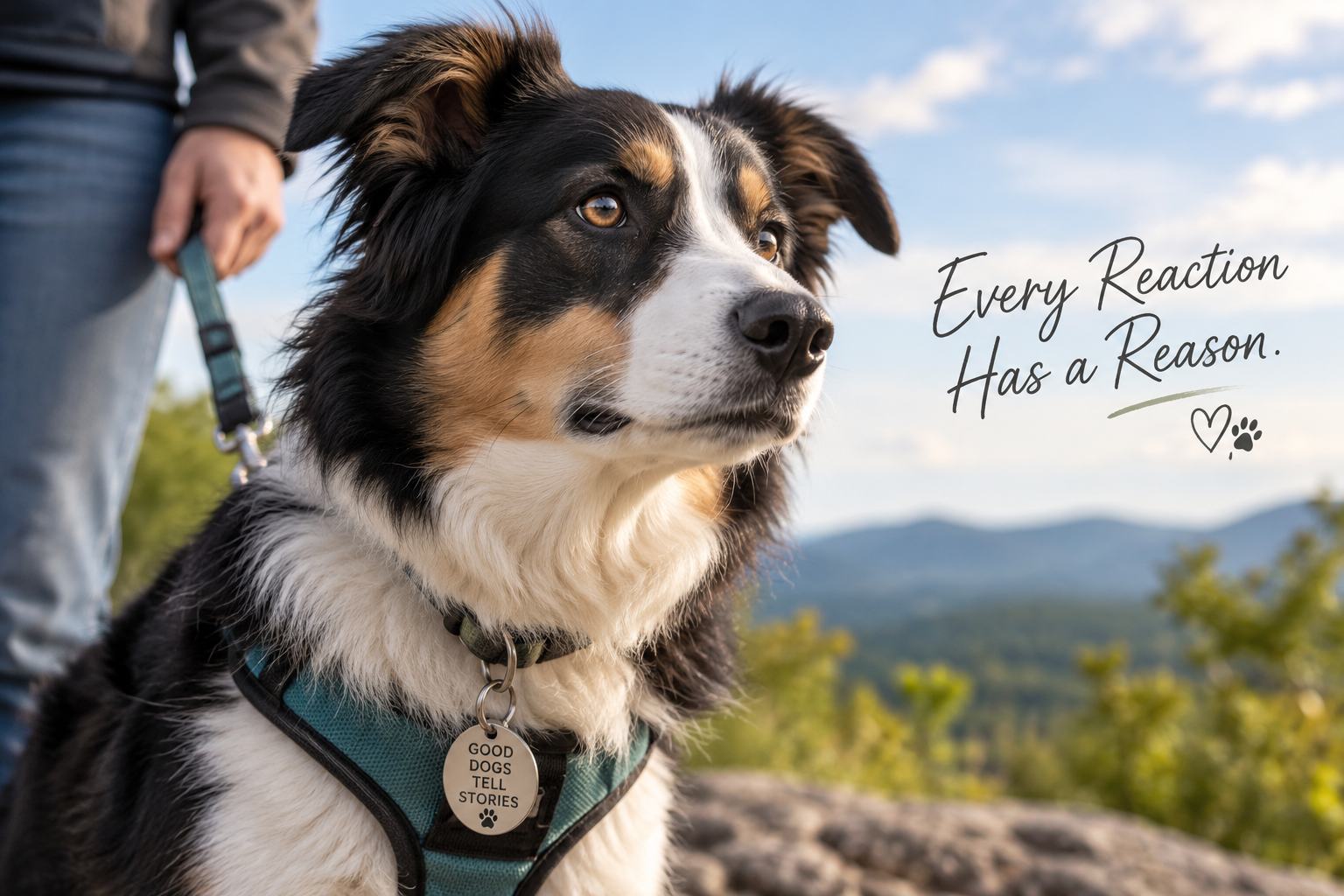
Your dog's reaction is communication. Let's learn how to decode it.
Private, individualized behavior support for reactive dogs and the people who love them.
Does This Sound Familiar?
You see the trigger. But your dog noticed it long before you did.
- Your dog suddenly freezes or stiffens.
- Their eyes lock onto another dog.
- Their body becomes tense.
- They stop responding to you.
- They bark, growl, lunge or pull.
- You feel like you have to avoid other dogs.
- You're constantly scanning the environment.
- You never know when the next reaction will happen.
And you're tired of being told to just "correct" it.
That's where our philosophy comes in.
Reactivity isn't something we simply "correct."
The reaction is information.
A reactive dog is experiencing an emotional response that can affect what they're able to perceive, process, and do in that moment.
Instead of asking
"How do I stop my dog from reacting?"
We ask
"What happened before the reaction — and what is my dog telling me?"
That's where decoding begins.
Observe → Decode → Understand → Connect
A simple framework that turns reactivity into a conversation you can actually have with your dog.
Observe
Learn your dog's body language and early stress signals.
Decode
Identify triggers, patterns, and thresholds before your dog reaches the explosion point.
Understand
Learn what you can do in real time to help your dog navigate the situation.
Connect
Build new skills, confidence, and coping strategies through carefully planned experiences.
"We don't train the reaction by provoking the reaction."
Your Dog Isn't a Training Level.
They're an Individual.
There is no one-size-fits-all plan for reactivity. One dog may be frightened. Another may be frustrated. Another may be overwhelmed. Another may have learned that reacting changes what happens around them.
That's why we start by understanding the dog — not by choosing a correction or checking boxes on an obedience curriculum.
Training as a Checklist
- Sit
- Down
- Stay
- Heel
- Place
- Certificate
But what does this dog actually need?
Training for the Individual
Understand the Dog
Identify the Need
Teach the Skill
Build the Relationship
We don't train for the certificate. We train for real life.
You're not a number. Your dog isn't a number.
We take the time to understand the individual dog and the people who live with them. The goal is not simply to produce obedience behaviors. The goal is to help the dog and human navigate real life more successfully.
Every dog deserves to be understood as an individual.
We train for the dog in front of us — and the life they need to live.
Why We Don't Do Board-and-Train
Your dog doesn't need someone else to learn your dog. You do.
A board-and-train may put the dog in someone else's environment with someone else's handling. But eventually…
the dog comes home to you.
That's why our work focuses on teaching the human-dog team.
You'll learn
- What your dog is communicating
- What happens before the reaction
- How to recognize early warning signs
- How to create appropriate distance
- How to respond when a trigger appears
- How to avoid rehearsing overwhelming reactions
- How to support your dog in everyday situations
The goal isn't for us to become your dog's handler.
The goal is for you to become your dog's decoder.
We Don't Set Your Dog Up to Fail
Training should create opportunities for success — not intentionally trigger an explosion.
Success, not explosions
Training should create opportunities for success — not intentionally trigger an explosion.
Dog and human together
We work with the dog and human together to identify the dog's threshold and develop strategies that allow learning to happen.
Without overwhelming
Strategies that allow learning to happen without unnecessarily overwhelming the dog.
"We don't train the reaction by provoking the reaction."
We don't intentionally provoke your dog into reacting simply to demonstrate that they're reactive or to practice "correcting" the reaction. Instead, we work with the dog and human together to identify the dog's threshold and develop strategies that allow learning to happen without unnecessarily overwhelming the dog.
That differentiates our approach from trainers whose marketing emphasizes "proofing," "corrections," "accountability," or deliberately putting dogs into difficult situations — and it does so without attacking anybody.
What Kind of Reactive Dog Do You Have?
Take the Reactive Dog Guru™ Quiz
Sample question
When your dog sees another dog, what happens first?
A. They freeze / stare
B. They immediately bark / lunge
C. They pull toward the dog
D. They try to move away
E. It varies
A Starting Point — Not a Label
Instead of saying "your dog is X," you'll get a starting point for understanding what you're seeing.
Your result might read
"Your dog's behavior suggests that emotional regulation and trigger awareness should be your starting point."
What to focus on first
- Recognizing early body-language changes
- Identifying your dog's threshold
- Preventing repeated overwhelming encounters
- Building handler communication
- Gradually developing coping skills
Your next step
Get your personalized mini-report and a short email series that walks you through decoding your dog — one sign at a time.
Tell Us About Your Dog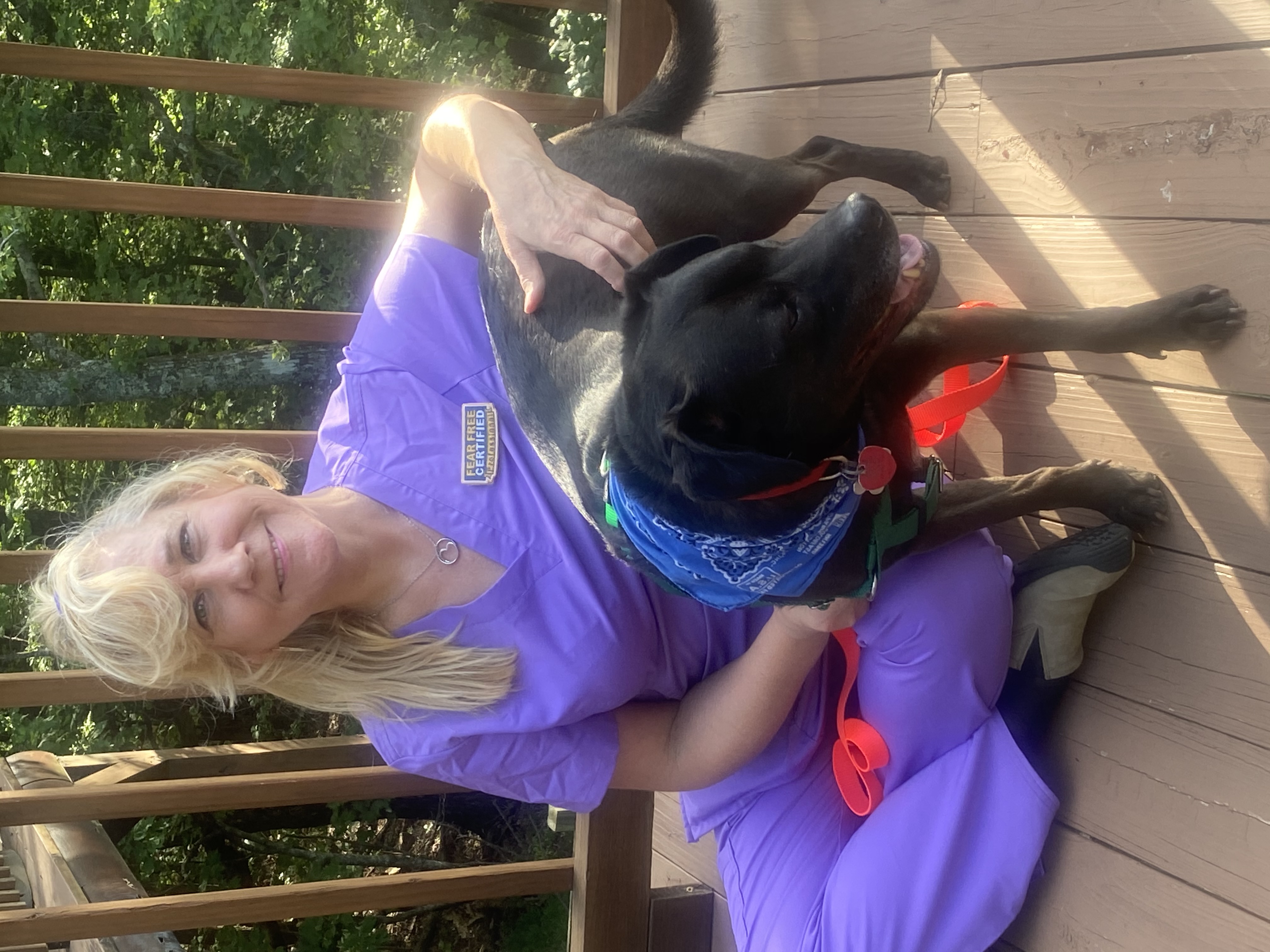
Meet Your Reactive Dog Guru
Linda Ross, B.A.– Psychology, DN-DTC • FDM • FFCP • LSHC-S
The Companion Animal Decoder™
Linda doesn't just train dogs. She teaches people how to understand them.
- DN-DTC
- FDM — Family Dog Mediator®
- FFCP — Fear Free® Certified Professional
- LSHC-S
- Dog Bite Safety Educator
- 20+ years working with companion animals
Reactive to Relaxed
Individualized behavior support for dogs who struggle with the world around them.
What it isn't
- Not a generic class.
- Not a one-size-fits-all protocol.
- Not "send your dog away and we'll fix it."
What it is
You + Your Dog + Us
Private sessions designed around your dog's individual triggers, environment, learning history, and needs.
Imagine…
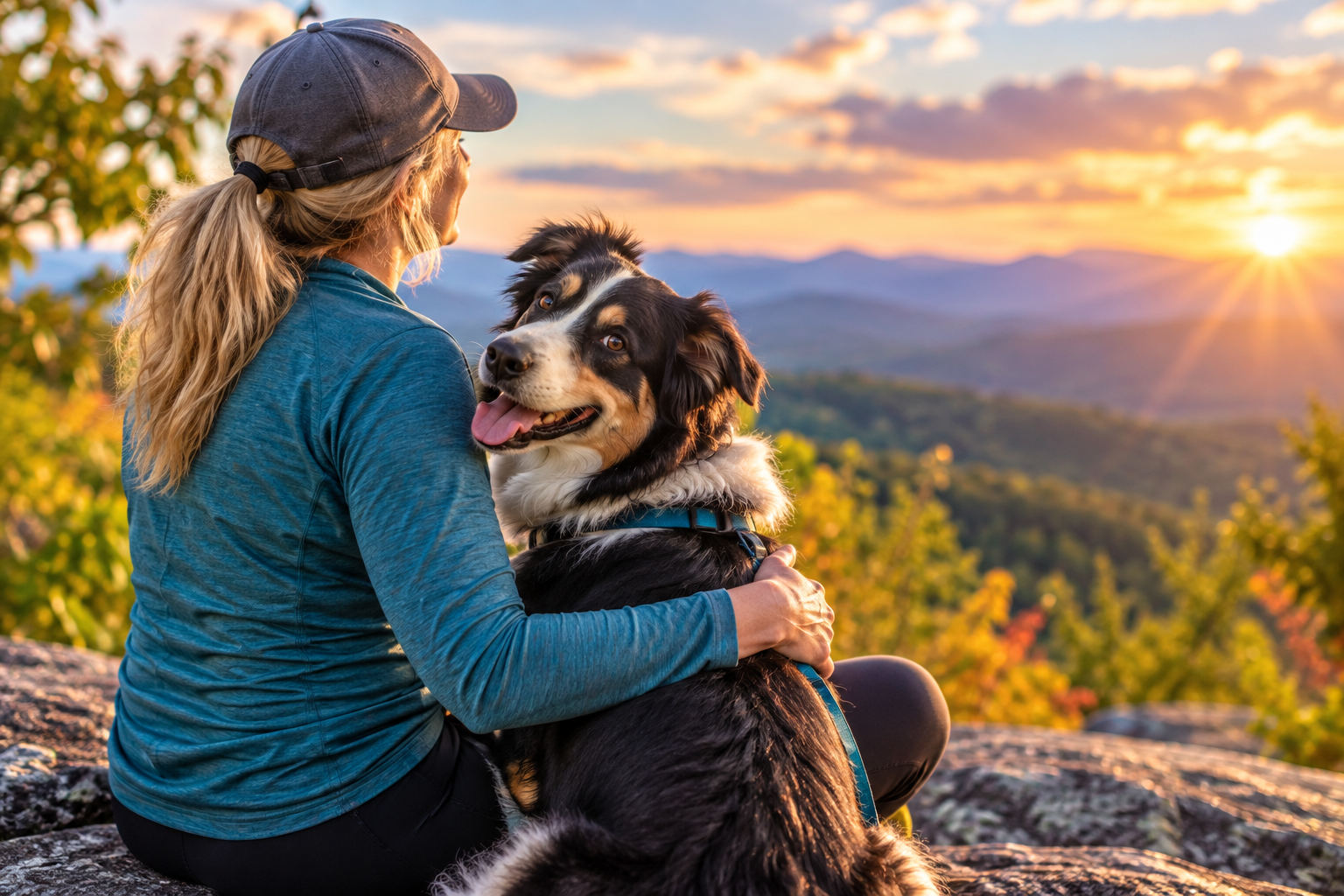
Instead of promising "No more reactivity!" we sell the life you're trying to get back.
- Taking your dog for a walk without constantly scanning the horizon.
- Knowing what your dog is telling you before the explosion.
- Being able to recognize: "She's starting to notice that dog." — instead of: "Oh no, here we go again."
- Having a plan when something unexpected happens.
Feeling like you and your dog are finally on the same team.
Ready to Get Started?
Start with the free quiz, or tell us what's going on with your dog.